Review of 'Life on Sark'
Life on Sark by Jennifer Chochrane
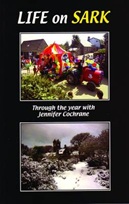 We visited Guernsey a few years ago with a highlight being a day trip to the Isle of Sark - A tiny “hunk of rock” only a short 50 minute ferry ride away from St. Peter's Port. Perched on the top of a rock promontory surrounded by steep cliffs the island has only about 500 inhabitants. Up until 2008 it was the last European feudal state with the hereditary Seigneur (lord) holding particular rights and responsibilities but now it is governed by it's own parliament (the “Chief Pleas”). Officially, it is a self-governing dependency of the British Crown, part of the Bailiwick of Guernsey. As with the rest of the channel islands Sark is not part of the UK, but owes allegiance to the British monarch so when they occasionally visit they are received with great enthusiasm.
In “Life on Sark”, resident Jennifer Cochrane talks about life on the island with a chapter for each month of the year, starting with April as this is when the Sark “season” begins as a big part of life on the island revolves around the tourists that visit. When they arrive at Maseline Harbour, carved out of the rock with a short jetty where the ferries moor up, they pass through a tunnel and are faced with a large hill up into the heart of the island. They can take the tourist “toast rack”, towed by a tractor, to the top or choose to walk. The top of the hill they have the choice of taking a horse-drawn cart around the island, walk, or hire a bike to get around. Other than tractors (and only at certain times of the day), there are no powered vehicles allowed on the island. There are several hotels, pubs, churches, shops, schools and halls in this small, tight-knit community.
Cochrane talks about what life is like beyond the tourist seasons and what it is like to actually live there. Though many make a living from tourists this cannot be their only source of income so some are also fisherman. Income is particularly important on the island as although it does not have income taxes (it has other, mostly property-based taxes) it also does not have public healthcare, unemployment insurance or pensions. The islanders do, however, pull together in times of hardship and look out for one another with various ad-hoc funds that are fed by various fundraising events held throughout the year.
A particular issue of life on the island is the frequency of the ferry which decreases significantly outside the busy summer. This is the main source of people and goods in and out of the island (there are also no aircraft allowed on the island) which can get even trickier when the weather is bad. Off-season they entertain themselves with various events including gatherings for various holidays, amateur dramatics (which the author has previously produced), entertaining events (including races and fairs) as well as the normal baptisms, weddings and funerals. For the most part the inhabitants very much enjoy the unique lifestyle of the island and the rugged beauty that surrounds them.
With the occasional photo, this short book offers a unique first-hand experience of what it is like to live in the unique community of Sark. There is very little in the way of talking about specific people that live on the island it rather focuses more on life in general. It is more documentary and, as such, comes across as quite dry, but, absolutely fascinating.
Rating: “Really good but I have some issues”
Review Date: 2026-02-21
Genre: Non-Fiction
Publisher: Seaflower Books
Publication Date: 2005
ISBN: 1903341256